Physics Guided-AI
Combine geophysical principles with modern AI to accelerate seismic interpretation while preserving physical realism.
Overview
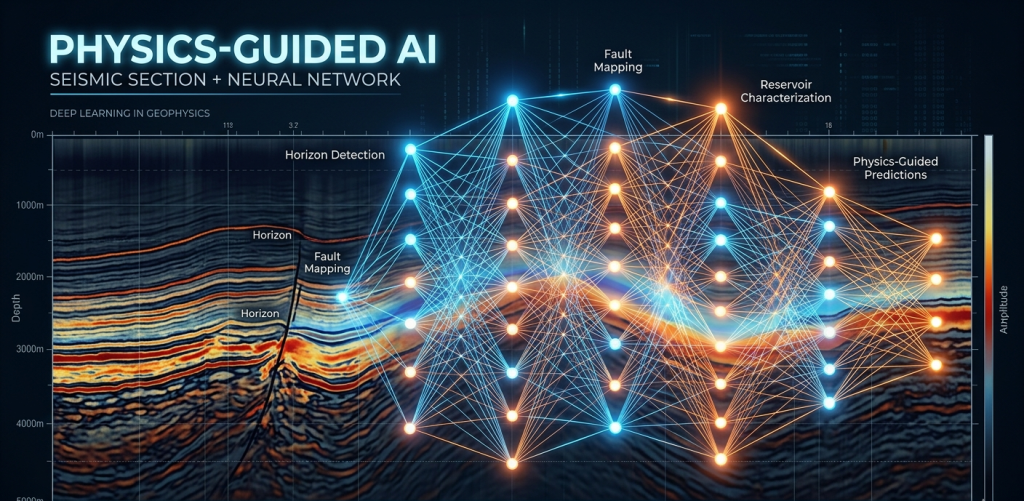
Traditional AI can detect patterns in seismic data, but without physics it can easily produce results that look plausible yet violate subsurface reality.
Our Physics Guided AI workflows embed geophysical principles directly into the AI models, ensuring that predictions remain consistent with wave propagation, structural geometry, and rock properties.
The result is faster interpretation, more reliable automation, and AI outputs that geoscientists can trust.
Key Capabilities
Fault Detection - Physics Guided AI
Physics‑guided AI detects faults by combining seismic attributes with structural rules to avoid noise‑driven false positives. The result is cleaner, more reliable fault picks.
Horizon Tracking - Physics Guided AI
Automated horizon picking guided by stratigraphic rules, structural trends, and seismic attributes
Physics‑Aware Seismic Attributes
Generation and enhancements of attributes that respect wavelet behavior, tuning, and rock property relationships
Facies & Feature Classification
machine Learning models that classify seismic facies while honoring geological context and structural boundaries
QC & Explainability
Workflows that provide confidence maps, uncertainty indicators, and geophysical meaning diagnostics
Integration with Existing Workflows
Seamless export to interpretation platforms and compatability with standard SEGY and attribute volumes
Workflow
- Data Preparation & QC We condition seismic data, attributes, and labels to ensure clean, consistent inputs for AI.
- Physics & Constraint Definition We define the structural, stratigraphic, and rock‑physics rules that guide the AI models.
- Model Training & Calibration AI models are trained and tuned using both data patterns and physics‑based constraints.
- Deployment on Seismic Volumes Models are applied to full 3D volumes to generate faults, horizons, facies, or attribute enhancements.
- QC, Iteration & Handover Results are reviewed with your team, refined where needed, and delivered in interpretation‑ready formats.
Articles and Insights
| Category — Article Title | Description |
|---|---|
| Physics Guided AI — A Complete Overview | Introduces AI workflows constrained by geophysical principles. |
| Fault Detection with Physics Guided AI | Shows how AI enhances fault interpretation using physics‑aware models. |
| Horizon Tracking with Physics Guided AI | Describes automated horizon extraction guided by geological rules. |
| Seismic Attributes — A Complete Overview | Comprehensive guide to attributes and how they reveal geological features. |
| Reservoir Characterization with Seismic Data | Explains how seismic‑derived properties support reservoir modeling. |
| Advanced Seismic Attributes — Beyond the Basics | Covers higher‑order and spectral attributes for detailed interpretation. |
| Machine Learning in Seismic Interpretation | Overview of ML techniques for faults, horizons, facies, and attribute extraction. |
| Seismic Interpretation — Fundamentals | Core principles of reading seismic data, identifying structures, and mapping geology. |
| Seismic Facies Analysis | Explains how seismic patterns reveal depositional environments and lithology. |
| Seismic Stratigraphy | Interprets depositional systems using onlap, downlap, truncation, and progradation. |
| The Future of Seismic Interpretation | Describes trends like AI, automation, cloud seismic, and real‑time monitoring. |
Why Choose US
Deep experience in both geophysics and machine learning
Physics‑guided workflows that avoid “black box” AI
Proven results in fault detection, horizon tracking, and attribute enhancement
Transparent QC and explainable outputs
Flexible deployment on your data and infrastructure
-Seamless integration with existing interpretation platforms
Ready to explore Physics Guided AI for your seismic data?
Let’s design an AI workflow that accelerates interpretation while honoring the physics of your subsurface