Seismic Processing That Brings Clarity to Your Subsurface
Padetech helps operators turn raw or legacy seismic data into clean, interpretable images that support drilling, development, and acreage evaluation.
Clear, Dependable Seismic Imaging
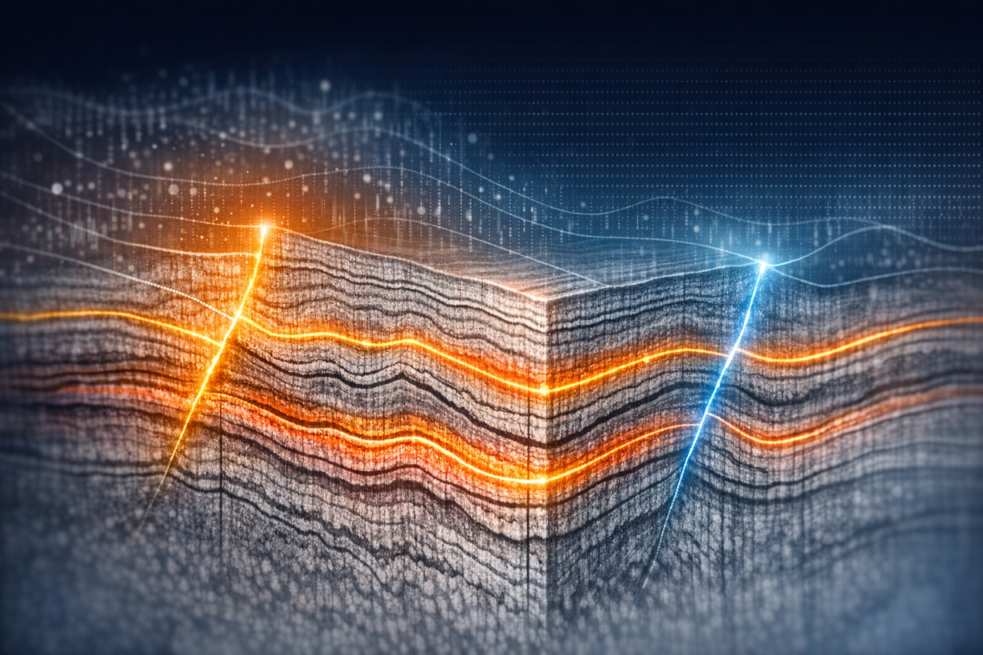
Clean seismic data is the foundation of confident decision‑making. Padetech enhances your seismic by removing noise, improving continuity, and delivering images that make structure easier to understand — without requiring in‑house geophysics expertise.
Noise Reduction
We remove unwanted noise and enhance true geological signal.
Improved Imaging
Cleaner, sharper seismic sections that make structure easier to understand.
Actionable Results
Deliverables designed for practical use — not just technical review.
Why Seismic Processing Matters
Better seismic clarity reduces drilling risk, improves acreage valuation, and helps teams communicate more effectively. Padetech delivers results that are easy to understand and ready to use — even if you don’t have a full geoscience team.
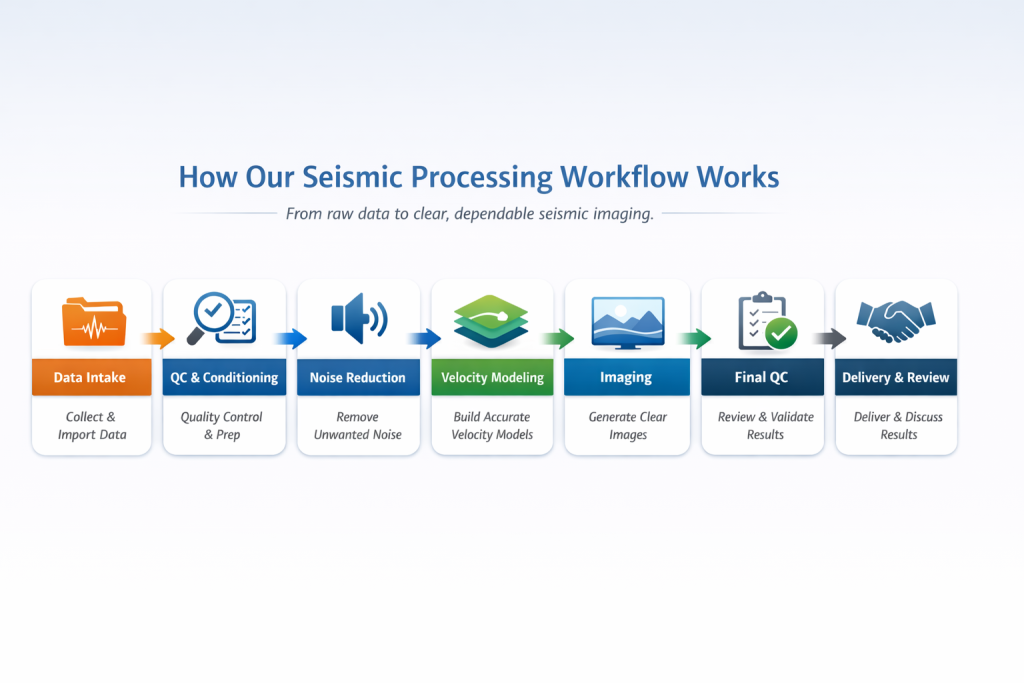
How Our Seismic Processing Workflow Works
Articles and Insights
| Article Title | Description |
|---|---|
| What is Seismic Data — A Complete Overview | End‑to‑end explanation of seismic processing from raw field data to migrated volumes. |
| Pre Stack vs Post Stack Explained | Compares pre‑stack and post‑stack domains and their impact on AVO, inversion, and imaging. |
| Time Depth Conversion — A Complete Overview | Covers methods for converting seismic time data into geological depth models. |
| Multiple Attenuation Explained | Describes techniques for identifying and removing multiples to improve seismic clarity. |
| Velocity Analysis — Full Overview | Explains how velocities are picked, refined, and used for stacking and migration. |
| Deconvolution Explained | Shows how deconvolution sharpens the wavelet and improves vertical resolution. |
| Migration — Full Overview | Details how migration collapses diffractions and positions reflectors correctly. |
| Stacking — How It Works | Explains how stacking increases signal‑to‑noise and enhances coherent reflections. |
| Seismic Noise — Types and Mitigation | Overview of noise sources and processing methods to suppress them. |
| What Is a Velocity Model? | Defines velocity models and their role in imaging, depth conversion, and inversion. |
| What Is AVO? | Introduces amplitude variation with offset and its use in predicting fluids and lithology. |
| Seismic Inversion — Fundamentals | Explains how inversion transforms seismic amplitudes into rock property volumes. |
| Full Waveform Inversion (FWI) — A Complete Overview | Describes how FWI uses full wavefields to build high‑resolution velocity models. |
| Seismic Data Conditioning | Covers filtering, scaling, de‑noising, and other steps that prepare seismic for analysis. |
| SEGY Format Explained | Breakdown of the SEGY standard, headers, traces, and why the format remains industry‑critical. |
| Seismic QC — What It Is and Why It Matters | Explains QC workflows that ensure seismic data is reliable, consistent, and interpretation‑ready. |
| Rock Physics — Fundamentals | Links seismic responses to lithology, fluids, porosity, and elastic properties. |
| Seismic Resolution — Vertical & Horizontal | Defines resolution limits and how they affect thin‑bed and structural interpretation. |
| Seismic Amplitude Interpretation | Shows how amplitudes relate to impedance, fluids, tuning, and processing effects. |
| Seismic Acquisition Basics | Overview of acquisition geometries, sources, receivers, and survey design principles. |
Ready to Improve Your Seismic Clarity
Whether you’re evaluating acreage or planning a well, Padetech can help you get more value from your seismic data.