
Machine Learning in Seismic Interpretation
Machine Learning in Seismic Interpretation
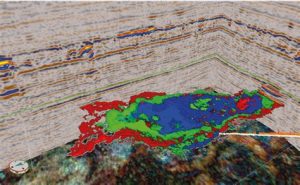
Introduction
Machine learning accelerates seismic interpretation by automating pattern recognition and extracting subtle geological features that may be difficult for humans to detect. As seismic datasets grow larger and more complex, ML has become an essential tool for improving efficiency, consistency, and geological insight.
1. Techniques
Machine learning in seismic interpretation typically uses four major categories of methods:
• Unsupervised Clustering
Groups seismic data based on similarity without labeled examples. Useful for facies classification, texture analysis, and anomaly detection.
• Supervised Classification
Trains models using labeled data (e.g., interpreter‑picked faults or facies). Ideal for automating repetitive interpretation tasks.
• Deep Learning
Neural networks (especially CNNs and U‑Nets) learn complex spatial patterns. Highly effective for fault detection, horizon tracking, and segmentation.
• Physics‑Guided AI
Combines machine learning with geophysical constraints. Improves reliability by ensuring outputs obey physical principles.
2. Applications
Machine learning enhances a wide range of seismic interpretation workflows:
• Fault Detection
Deep learning models can automatically identify faults with high accuracy.
• Horizon Tracking
ML accelerates horizon picking and reduces interpreter bias.
• Facies Classification
Unsupervised and supervised methods reveal depositional patterns and reservoir architecture.
• Attribute Extraction
AI can generate new attributes or optimize combinations of existing ones.
These applications significantly improve interpreter productivity and consistency.
Conclusion
Machine learning enhances seismic interpretation by automating pattern recognition and revealing subtle geological features. When combined with physics‑based methods and expert QC, ML becomes a powerful tool for modern subsurface analysis.