
Seismic Stratigraphy
Seismic Stratigraphy
Introduction
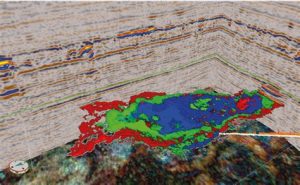
Seismic stratigraphy interprets depositional systems using seismic reflection patterns. By analyzing how reflections terminate, stack, and evolve, interpreters can reconstruct basin history, reservoir architecture, and stratigraphic traps. It is a foundational technique for understanding sedimentary processes and predicting reservoir distribution.
1. Key Concepts
Seismic stratigraphy relies on characteristic reflection terminations and stacking patterns:
• Onlap
Reflections terminate against an inclined surface, indicating transgression or accommodation increase.
• Downlap
Reflections converge downward onto a surface, often marking progradation.
• Toplap
Reflections terminate upward due to non‑deposition or erosion.
• Truncation
Reflections are cut by an erosional surface.
• Progradation
Outward building of sedimentary packages.
• Aggradation
Vertical stacking due to balanced sediment supply and accommodation.
These patterns reveal depositional environments and stratigraphic evolution.
2. Tools
Several tools enhance seismic stratigraphic interpretation:
• Attributes
Highlight reflection terminations, channels, and depositional geometries.
• Spectral Decomposition
Reveals thin beds, channels, and stratigraphic features at different frequencies.
• Facies Analysis
Groups seismic textures to identify depositional elements.
Together, these tools help interpreters map stratigraphic architecture with greater confidence.
3. Applications
Seismic stratigraphy is widely used in exploration and development:
• Channel Mapping
Identify fluvial, deltaic, and deepwater channels.
• Carbonate Systems
Map reefs, build‑ups, and platform margins.
• Deepwater Fans
Interpret lobes, levees, and turbidite systems.
• Unconformity Analysis
Understand basin evolution, erosion, and sequence boundaries.
These applications support reservoir prediction and stratigraphic trap identification.
Conclusion
Seismic stratigraphy connects seismic patterns to depositional processes, enabling powerful geological interpretation. By integrating reflection terminations, attributes, and facies analysis, interpreters can reconstruct basin history and predict reservoir distribution with greater accuracy.