
Seismic Facies — Understanding Subsurface Patterns
Seismic Facies — Understanding Subsurface Patterns
Introduction
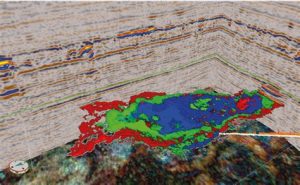
Seismic facies analysis is a powerful interpretation technique that groups seismic reflections based on their patterns, textures, and attributes. These facies help interpreters understand depositional environments, reservoir architecture, and stratigraphic variability. Seismic facies are essential for reservoir characterization, geomodeling, and stratigraphic interpretation.
This article explains what seismic facies are, how they are identified, and why they matter.
1. What Are Seismic Facies?
Seismic facies are mappable units of seismic reflections that share similar characteristics, such as:
Amplitude
Continuity
Frequency
Geometry
Reflection configuration
These characteristics reflect changes in:
Lithology
Depositional environment
Fluid content
Reservoir quality
Seismic facies bridge the gap between seismic data and geological interpretation.
2. How Seismic Facies Are Identified
Interpreters analyze reflection patterns using:
A. Reflection Geometry
Parallel
Divergent
Chaotic
Mounded
Onlapping / downlapping
These patterns indicate depositional processes.
B. Seismic Attributes
Attributes highlight subtle variations in:
Texture
Amplitude
Frequency
Discontinuity
Common attribute inputs include coherence, curvature, spectral decomposition, and RMS amplitude.
C. Machine Learning & AI
Modern workflows use:
Self‑organizing maps (SOM)
Unsupervised clustering
Deep‑learning facies classification
These methods reveal patterns not easily seen by the human eye.
3. Seismic Facies Workflow
Data conditioning
Attribute selection
Facies classification (manual or AI‑assisted)
Cross‑plotting and cluster validation
Geological calibration with wells
Facies mapping and interpretation
Calibration with well logs is essential to ensure facies have geological meaning.
4. Applications of Seismic Facies
✔ Depositional environment interpretation
Identify channels, lobes, reefs, deltas, and turbidites.
✔ Reservoir characterization
Map reservoir quality and heterogeneity.
✔ Stratigraphic analysis
Understand pinchouts, unconformities, and facies transitions.
✔ Geomodeling
Provide facies inputs for static reservoir models.
✔ Exploration risk reduction
Improve predictions of reservoir presence and quality.
5. Challenges
Noise and poor data quality
Attribute redundancy
Over‑classification
Limited well control
Interpreter bias
AI and physics‑guided workflows help reduce these challenges.
Conclusion
Seismic facies analysis transforms seismic data into meaningful geological patterns. By integrating attributes, machine learning, and well calibration, interpreters can map depositional systems, predict reservoir quality, and reduce exploration uncertainty. Seismic facies are a cornerstone of modern reservoir characterization.